Coated Paper vs Film Labels Comparison
We compare coated paper and film labels by surface, print quality, durability, water and moisture resistance, tearing behaviour, cost and application areas.
One of the most common decisions in label selection is the choice between coated paper and film material. Both can be processed on similar printing equipment and produced with the same cutting dies and roll layouts. Even so, their surface structures, durability and cost balances differ noticeably. The right decision therefore depends on the product usage conditions and the brand expectation.
In this guide we compare coated paper and film labels in terms of surface and print quality, durability, water, oil and moisture resistance, tearing behaviour, cost and application areas. Our aim is to make it technically clear which material suits which product and to simplify the selection process.
What are coated paper and film labels
A coated paper label is a paper based material with a coated surface. The coating helps the ink adhere more evenly and delivers clean results in fine detailed printing. A film label is built on a synthetic base such as polypropylene or polyester. Compared with paper, this base offers a more flexible, more durable and usually smoother surface.
The structure of coated paper labels
Coated paper labels usually consist of three layers: the coated surface, the paper base and the adhesive. The coating is the main element that determines print quality. Different visual effects can be achieved with matt, gloss or semi matt options. Because the paper base can be affected by moisture, it should be evaluated carefully on surfaces that stay wet for a long time or face heavy friction.
The structure of film labels
Film labels are produced from polypropylene, polyester or a similar synthetic film. This structure is more resistant to water, oil and moisture than paper. Because the surface is smooth, it is frequently preferred for glossy beverage labels and premium cosmetic packaging. Different surface options are available such as clear, white, metallised and matt.
Surface and print quality
Print quality depends on the interaction between the ink and the surface. Thanks to its absorbent structure, coated paper accepts ink quickly and offers rich colour transitions, especially in offset and flexo printing. A film surface is not absorbent, so a suitable printing technology and correct surface preparation are required for the ink to dry.
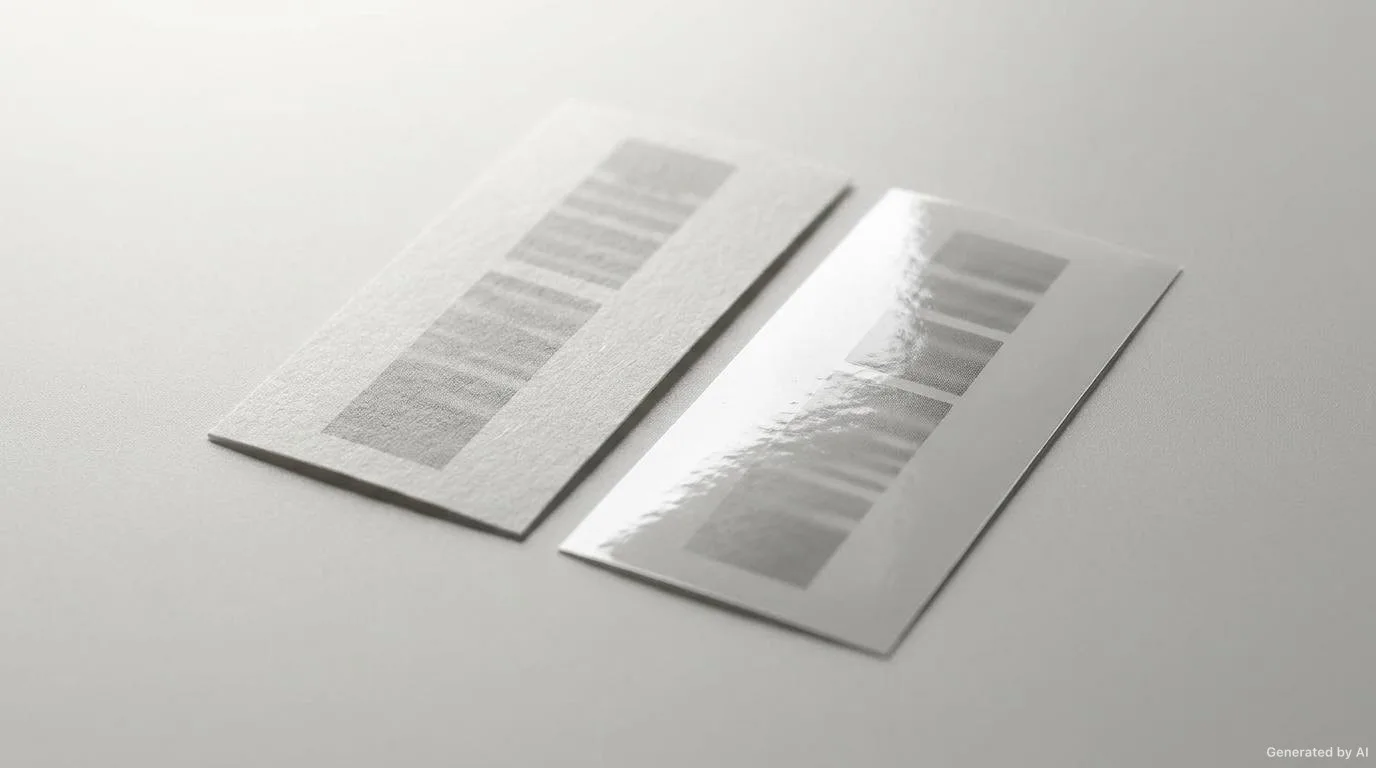
In areas that require sharpness, such as fine lines, small text and barcodes, both materials can deliver successful results. Compared with uncoated paper, however, coated paper gives a fuller look in designs that contain photos and gradients. On film labels the colours can appear more vivid and saturated; in particular, white printing on clear film creates a look that blends with the product itself.
Surface texture and perception
Matt surfaces give a calm and natural impression, while glossy surfaces create an eye catching and modern perception. Coated paper feels natural to the touch, whereas film has a smoother, plastic like texture. Brands aiming for premium positioning frequently consider clear film or soft touch style coatings.
Printing technologies and material compatibility
Not every printing technology gives the same result on every material. Flexo printing is an economical solution for high volume roll work and is widely used especially on film surfaces. Digital printing provides flexibility for low and medium volumes that require variable data and personalisation. Thermal printing is a different approach and is generally preferred for logistics tracking labels.
Defining the intended printing technology from the start reduces compatibility problems later on. Coated paper works well with offset and flexo, while film material can deliver high resolution in digital printing. The surfaces used in thermal labels require a separate chemical structure and should therefore not be confused with ordinary coated paper or film.
Durability: resistance to water, oil and moisture
Durability is one of the clearest differences between the two materials. Coated paper can resist brief moisture, but when it stays wet for a long time it may swell, ripple and become more prone to tearing. This becomes obvious in applications such as the cold chain, refrigerators or iced beverages.
Film labels are more resistant to water and oil. They hold their shape better under dripping liquids, condensation and low temperature conditions. On products that come into contact with oily surfaces, especially food packaging, film material usually gives a more reliable result. Even so, every adhesive and surface pairing should be assessed separately.
The role of adhesive selection
Alongside the durability of the material, the adhesive used also determines total performance. Adhesives developed for cold environments and suitable for damp or oily surfaces are available. Even when coated paper and film are used on the same surface, bonding can differ according to the adhesive type. For this reason, carrying out sample testing is a sound approach.
Tearing and deformation behaviour
Coated paper is not as flexible as film against impacts and pulling force. On sharp edged surfaces or continuously rubbing areas, tearing and edge lifting can occur. Thanks to their flexible structure, film labels better withstand tension and show less deformation on shrinking or rotating surfaces.
For packaging that bends and flexes, especially squeezable bottles, choosing film labels is more appropriate. On flat and rigid surfaces, coated paper offers a sufficient and balanced solution in terms of both appearance and cost.
Cost and supply assessment
In terms of cost, coated paper labels are generally more economical than film labels. On high volume jobs the paper base can noticeably reduce the unit cost. Film labels carry a higher raw material cost; on the other hand, in applications that require durability they can balance the total cost of ownership by reducing the need for relabelling.
Looking only at the unit price of the label is not enough when assessing total cost. Printing setup times, waste rates, application speed and return risks should also be taken into account. Choosing a durable material for a long lived product may look more expensive at first but can save money throughout the process.
Preference by application area
Food and beverage
Coated paper labels are often sufficient for dry food and products stored at room temperature. For iced beverages, the cold chain and products exposed to condensation, a film label is a more reliable option. Clear film is frequently preferred on beverage packaging that wants to show the product itself.
Logistics and storage
In logistics labels, surface friction and ambient moisture are decisive. On surfaces exposed to friction during transport, film material lasts longer. For barcode and tracking labels, preserving readability is a priority, so the durability requirement must always be assessed.
Cosmetics and personal care
In cosmetic products, visual perception is decisive. On bottles exposed to moisture in a bathroom environment, a film label provides durability. For premium positioning, soft touch film or matt coated options can be considered.
Coated paper and film label comparison table
| Criterion | Coated paper label | Film label |
|---|---|---|
| Surface | Natural, slightly textured | Smooth, synthetic |
| Print quality | Rich colour, full look | Vivid and saturated colour |
| Water resistance | Short term, limited | High |
| Oil resistance | Limited | High |
| Moisture resistance | Low | High |
| Tearing behaviour | Tears easily | Flexible and resistant |
| Cost | Usually more economical | Higher |
| Prominent use | Dry food, boxes, room temperature | Beverages, cold chain, cosmetics |
Checklist before selection
- Is the product surface flat, or curved and shrinking?
- Will the label be exposed to water, oil or condensation?
- Will the product be stored in the cold chain or in a refrigerator?
- Is the surface exposed to friction or impact?
- Does the print contain fine detail, gradients or photos?
- Is a clear, matt or metallised look intended?
- What is the annual volume and budget range?
- Have the adhesive, surface and environmental conditions been tested together?
Sample product scenarios
For products sold at room temperature such as a jar of honey or jam, a coated paper label is usually sufficient. Even if the jar is wiped regularly, the label can withstand brief moisture. However, if the product is kept in a refrigerator continuously or condensation forms on the surface, a film label becomes a more appropriate choice.
For products used in wet environments such as shampoo and shower gel, moisture and temperature fluctuations are decisive. On such packaging a film label reduces the risk of edge lifting and fading. When clear film is used, the colour of the product comes forward and the label blends with the packaging.
On courier and warehouse labels, friction and ambient moisture come to the fore. In this scenario a durable film material helps preserve barcode readability. In contrast, on short lived labels that stay in a dry environment, coated paper offers both an economical and sufficient solution.
These scenarios show how much the material choice depends on how the product is stored and used. The same brand can use different label solutions across different product groups. What matters is to assess moisture, temperature, friction and visual expectation separately for each product.
The production volume should also be considered when deciding. Staying with a single material offers a supply advantage on high volume jobs, while for brands with a wide product range, flexibility becomes more important. Striking this balance well helps manage both cost and quality together.
Conclusion and next steps
Coated paper and film labels are not rivals but two separate solutions that answer different needs. In dry and protected environments coated paper offers an economical and elegant option; when moisture, water and friction are involved, film labels stand out with their durability. Considering the whole life cycle of the product is the soundest approach when deciding.
For a broader view you can look at our label selection guide or review the material comparison we prepared for demanding conditions: label selection guide and industrial labels material selection. To define the most suitable material for your application together, you can reach us through our label solutions page and we can plan the sample and quotation process together.
Frequently Asked Questions
What happens when a coated paper label gets wet?
Coated paper can resist brief moisture, but if it stays wet for a long time it swells, ripples and becomes easier to tear. For wet or cold environments a film label is usually more suitable.
For which products is a film label ideal?
Cold beverages, cold chain and refrigerated products, plus damp or oily surfaces, are where film labels stand out. They are also widely used on cosmetic packaging.
Are coated paper labels more economical?
Usually yes. On high volume jobs coated paper lowers the unit cost. However total cost should also consider durability and the need for relabelling.
Which material reads better for barcode printing?
Both materials can produce a clear barcode. The deciding factors are print quality, surface smoothness and environmental conditions. On barcodes exposed to friction and moisture, film labels keep readability longer.
How do I choose the right material?
You should evaluate the product surface, storage conditions, friction and moisture exposure and the budget together. Sample testing is the most reliable method.
Want to Determine the Right Label for Your Product?
Share your usage area and needs with us; let's evaluate suitable options together.