What Information Should You Provide When Requesting a Label Sample?
When requesting a label sample (proof), details such as size, quantity, surface, application method and print expectations must be accurate. This guide explains what to share and how the sample process works.
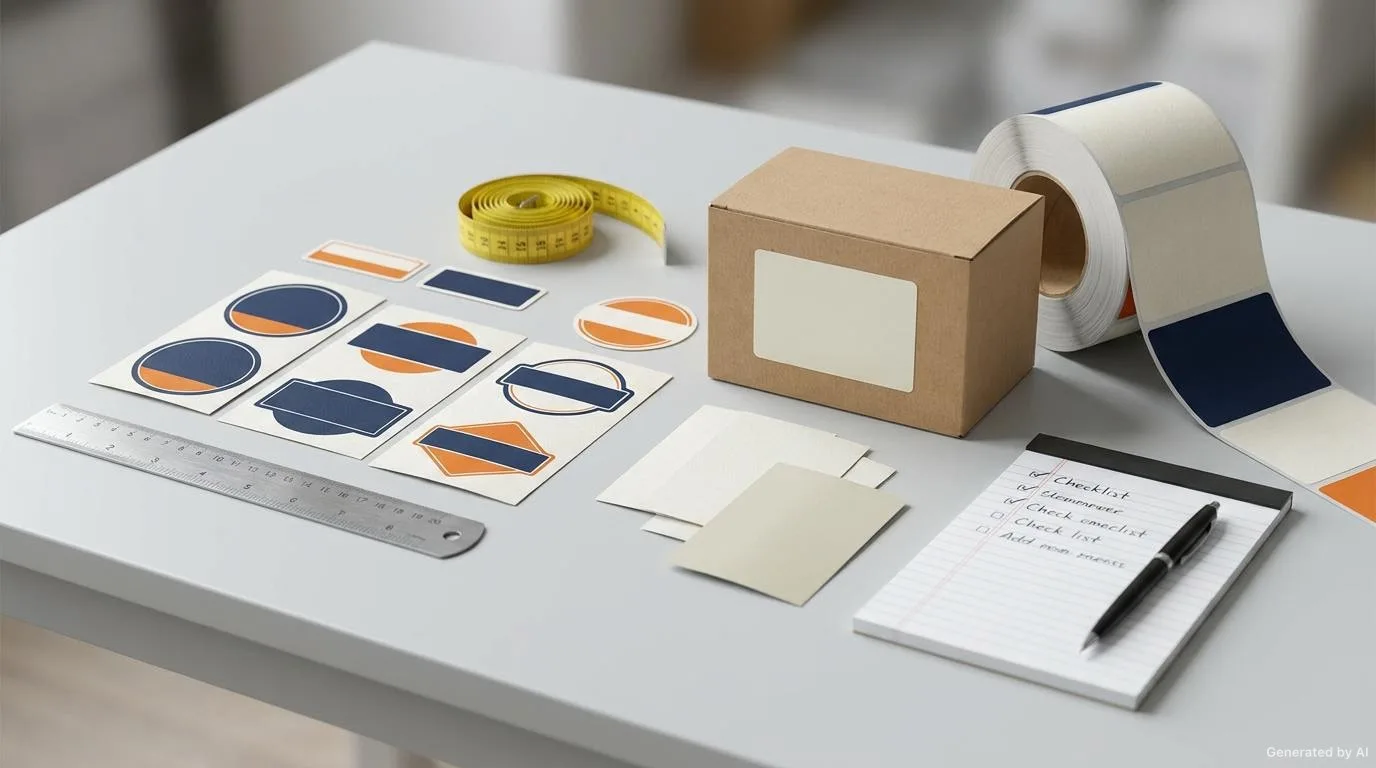
The short answer to what you should provide when requesting a label sample (proof) is this: a sample is a small-scale representation of the label that will be produced in series, so your size, quantity, application surface, application method, storage conditions, adhesive and print expectations must be clear from the very start. The more accurate the information you share, the more realistic the sample you receive, and the fewer surprises you will face when moving to full production.
What Is a Label Sample (Proof) and Why Request One?
A sample is a small example prepared before ordering so you can assess how the material, adhesive, print and surface finish will actually look. The aim is to see whether the label fits your product and packaging before committing to full-scale production.
A sample request has three main benefits: confirming how the label behaves on your surface, evaluating colour and print quality, and making sure the material and adhesive choice is right. A well-informed sample shortens the entire process and prevents unnecessary repeats.
Sample vs. Full Production
A sample is usually produced in small quantities with a fast method (such as digital printing), while full production runs on the final printing technology, die/plate and the actual material batch. For this reason the sample is a reliable guide for size, material and adhesive feel, but an exact colour-tone match should not always be expected. Knowing the difference between the two stages helps you interpret the sample correctly.
Essential Information to Provide in a Sample Request
The table below summarises the key information a sample request should contain and why each item matters.
| Information to provide | Why it matters |
|---|---|
| Label size and shape | Ensures the sample is produced at the right cut and proportion; if the size is wrong, the sample will not fit your product. |
| Quantity and expected annual volume | Determines the sampling method and the printing technology that will be recommended. |
| Application surface and packaging type | The most critical information, as it decides whether the adhesive will stick. |
| Application method (manual/automatic) | The roll winding direction, gap and layout are adjusted accordingly. |
| Storage and usage conditions | Temperature, humidity, cold or outdoor exposure directly affect label life. |
| Adhesive expectation (permanent/removable) | Ensures the correct adhesive type is selected. |
| Surface finish (matte/gloss/lamination) | Determines visual perception and durability. |
| Print requirements (colour, variable data, barcode/QR) | The printing method and readability are planned accordingly. |
| Roll or sheet | Determines compatibility with your application equipment. |
| Delivery address and required date | Necessary for planning and logistics. |
| Current supplier or sample photo | Makes matching easier by using a reference. |
| Design file status | Shows whether the sample can be prepared with the real design. |
When this information is complete, the sample is prepared correctly on the first attempt and the need for repeat samples drops noticeably.
Label Size, Shape and Roll vs. Sheet Preference
Size is the most fundamental input for a sample. Width and height should be stated in millimetres, with acceptable tolerances where possible. The shape (round, square, oval or custom die-cut) and, if any, the corner radius should also be shared, because the cut shape affects both the appearance of the sample and how easily it applies.
Roll or sheet preference directly affects the sample. A roll suits automatic labelling machines, while a sheet may be preferred for manual application or office-type printers. If this preference is not stated up front, the sample may be prepared in a format that does not fit your equipment. For details on roll orders, see our article on what to know before ordering roll labels.
Quantity and Expected Annual Volume
Even if the sample quantity is small, it is very valuable to state the quantity you are planning for full production and, if possible, an estimated annual volume. Quantity directly affects the printing method, the use of a die and the unit cost.
A small sample order and high-volume production are not printed with the same technology. When you share this information, the sample is prepared with the method closest to your real job, and the gap between sample and production narrows.
Application Surface, Packaging Type and Application Method
The surface the label will be applied to is the most critical information you can give for a sample. Glass, plastic, metal, carton and paper all behave differently when it comes to adhesion. On a rough or low-surface-energy surface, a label can lift during sampling if the adhesive is not chosen correctly. The surface type and packaging form should therefore be stated clearly.
Whether the application is done by hand or with an automatic machine should also be shared. Manual application allows wider tolerances, whereas on automatic systems the roll winding direction, the gap between labels and the cut layout matter greatly. A sample prepared without knowing the application method can cause problems on the production line.
Storage and Usage Conditions
The conditions in which the label will be stored and used determine the choice of material and adhesive. Will your product sit in a refrigerator, a freezer or outdoors? What temperature range and humidity will it be exposed to during and after application?
Factors such as cold, humidity and sunlight affect how the label sticks and how readable it stays over time. Stating these conditions up front ensures the sample is prepared to reflect your real usage scenario. For demanding conditions, the approaches in our article on water, humidity and outdoor-resistant labels can be a useful guide.
Adhesive Expectation and Surface Finish
You need to clarify whether the label should be permanent or removable. A permanent adhesive aims to keep the label firmly in place on the surface for a long time, while a removable adhesive aims to be taken off without leaving residue. This expectation forms the basis for choosing the right adhesive.
The surface finish is also something that should be visible in the sample: a matte, gloss or laminated surface changes the label's visual perception, its reflectivity and its resistance to wear. Stating which finish you want ensures the sample reflects your expectations. For the details of adhesive selection, see our article on how to choose a label adhesive.
Print Requirements: Colour, Variable Data and Codes
You should also state the print features you want to see in the sample from the start. How many colours will be used? Are there critical tones such as a brand colour? Do you want the sample prepared with the real design or with a temporary artwork?
Also, will the label carry variable data (serial number, lot, date) or a barcode/QR code? These elements affect the printing method, resolution and readability requirement. If these details are not shared, the sample may not be sufficient for the final product. For barcode work, our article on barcode labels: correct printing and readability is helpful.
Design File, Current Supplier and Reference Product
Preparing the sample with your real design gives the healthiest assessment. You should therefore state the status of your print-ready design file up front (ready, to be prepared, and in which format). If you do not have a design file, a sample can also be prepared from a temporary artwork using your size and content details.
If you already use a label, sharing your current supplier and, if possible, a sample photo makes the job much easier. Working from a reference product or an existing example helps the new label reach the intended look and performance faster.
How Does the Sample Process Work?
The sample process usually moves through a few steps, and your feedback at each step contributes to it:
- 1. Information gathering: your size, quantity, surface, conditions and print expectations are collected.
- 2. Evaluation: the material, adhesive and printing method are determined.
- 3. Sample production: a sample is prepared with the defined features.
- 4. Approval: you review the sample and, if needed, request small adjustments.
- 5. Full production: production is planned based on the approved sample.
In this cycle, sample approval is a critical threshold; the approved sample is taken as the reference for the following production.
Checklist for a Label Sample Request
Reviewing the following items before sending your request speeds up the process:
- Is the label's width × height and shape clear?
- Is a roll or a sheet preferred?
- Are the sample and production quantities (and, if possible, annual volume) stated?
- Is the application surface and packaging type written down?
- Will the application be manual or by automatic machine?
- Are the storage and usage conditions (temperature, humidity, outdoor, cold) shared?
- Is it stated whether permanent or removable adhesive is wanted?
- Is a surface-finish preference (matte/gloss/lamination) given?
- Are the print colours, variable data and barcode/QR requirements clarified?
- Is the delivery address and required date provided?
- Is a current supplier, sample photo or reference product attached?
- Is the status of the design file stated?
Common Problems When Moving from Sample to Production
Even after a sample is approved, problems can arise in full production when some information is missing. Anticipating these makes the job far easier:
- The label not fitting the packaging exactly because no size tolerance was specified.
- The roll winding direction being reversed for the machine, causing slippage during application.
- The colour tone differing between the sample and full production.
- The label lifting due to insufficient adhesion on the surface.
- The variable data or barcode size being too small to read.
- A change of delivery date or quantity upsetting the plan.
A Realistic Use Scenario
A small olive-oil producer wants labels designed for new glass bottles. At first the producer asks only for a "sample"; but if size, surface and conditions are not shared, the sample may be prepared with a material that does not suit the glass bottle.
Instead, the producer states the bottle size, that the label will be applied by hand, that the product will be kept in a cool warehouse and occasionally in a refrigerator, that a matte surface is wanted, and that around 20,000 units are planned for full production. The sample prepared with this information reflects the real product conditions; once the producer approves it, the move to full production goes smoothly. As this shows, sharing the right information makes the sample accurate on the first try.
Conclusion and Actionable Recommendations
Success in a sample request largely depends on the accuracy of the information you give. When you clarify your size, quantity, surface, application method, conditions, adhesive and print expectations from the start, the sample fits your job on the first attempt and the move to production is smooth.
For a broader view of the process, you can read our article a checklist for preparing a quote for the right label solution. For material and technical details, our articles on technical questions when choosing label material and the label selection guide are useful guides. For suitable options, browse our products page.
A Quote Tailored to You
For your label sample request, simply share your size, quantity, surface, application method and usage conditions. Our team will evaluate the most suitable material and adhesive for your needs and get back to you. Click here to request a sample and a quote.
Frequently Asked Questions
What is the most critical information in a sample request?
The application surface and the usage conditions; these two details directly determine the choice of material and adhesive.
Is a sample chargeable?
It depends on quantity, material and company policy. In some cases a sample is provided free of charge, while custom production may carry a fee; you can ask for the exact terms in your request.
Will the sample be identical to full production?
The sample is a guide: it represents the material and the adhesive feel. If the printing method differs, small colour-tone differences may appear, but size and material stay the same.
How long does it take to prepare a sample?
The time depends on material availability, printing method and workload. You can ask for the most suitable delivery date in your request.
Can I request a sample without a design file?
Yes. By sharing your size and content details, a sample can be prepared from a temporary artwork so you can evaluate the material and adhesive in advance.
Want to Determine the Right Label for Your Product?
Share your usage area and needs with us; let's evaluate suitable options together.