Removable Labels and Permanent Adhesive Labels
We compare label types by adhesive behaviour (permanent, removable, repositionable, residue-free, cold and high-tack) and cover surface, temperature, residue risk and selection criteria with a practical checklist.
One of the most misunderstood points in label selection is not how strong an adhesive is, but how it behaves. Two adhesives with similar holding power can produce completely different results when one is permanent and the other is removable. Some labels leave no trace when removed, some tear and never re-stick, and others can be applied, lifted and re-applied again. In this article we classify removable and permanent adhesive labels together with repositionable, residue-free, cold/freeze and high-tack types, and provide a practical framework for choosing the right one for each job.
Short answer: whether a label should be permanent or removable depends on the surface, how long the label stays on the product, whether it must later be removed, and whether residue is acceptable. The right class varies with the product, packaging, temperature and target market, and the most reliable decision is made with a sample test.
Label classes by adhesive behaviour
Adhesives are defined by three core properties: initial tack, ultimate adhesion and clean removability. Initial tack describes how quickly a label grips the moment it touches the surface; ultimate adhesion describes the strength of the bond that develops over time and under pressure. Removability is a separate property, which means a label can hold very well and still come off cleanly when you want it to.
When these three properties combine in different ways, the following classes emerge: permanent, removable, repositionable, residue-free (ultra-removable), cold/freeze and high-tack. The practical value of this classification is simple: the strongest adhesive is not always the right choice. A permanent adhesive soils the surface on a label that must later be removed, while a very weak adhesive can lift on its own during transport.
Good selection starts with defining the label's service life. Will the label stay with the product, or will it be removed at some point? This single question sets the first branch of the decision tree.
Permanent adhesive labels
Permanent adhesives are designed to bond firmly to the surface after application and, under normal conditions, to leave residue or tear when someone tries to remove them. The goal is that the label stays with the product and does not lift on its own. These adhesives actually get stronger over time, because the contact between adhesive and surface settles under pressure and heat.
Permanent adhesives are typically used for product labels, statutory information labels, food and cosmetic packaging labels, and logistics and inventory labels. When long shelf life, transport and stacking resistance are required, a permanent solution is the right choice. However, a permanent adhesive can cause problems on a product that must later be removed, re-labelled, or come off cleanly for return and recycling processes.
Removable (peelable) labels
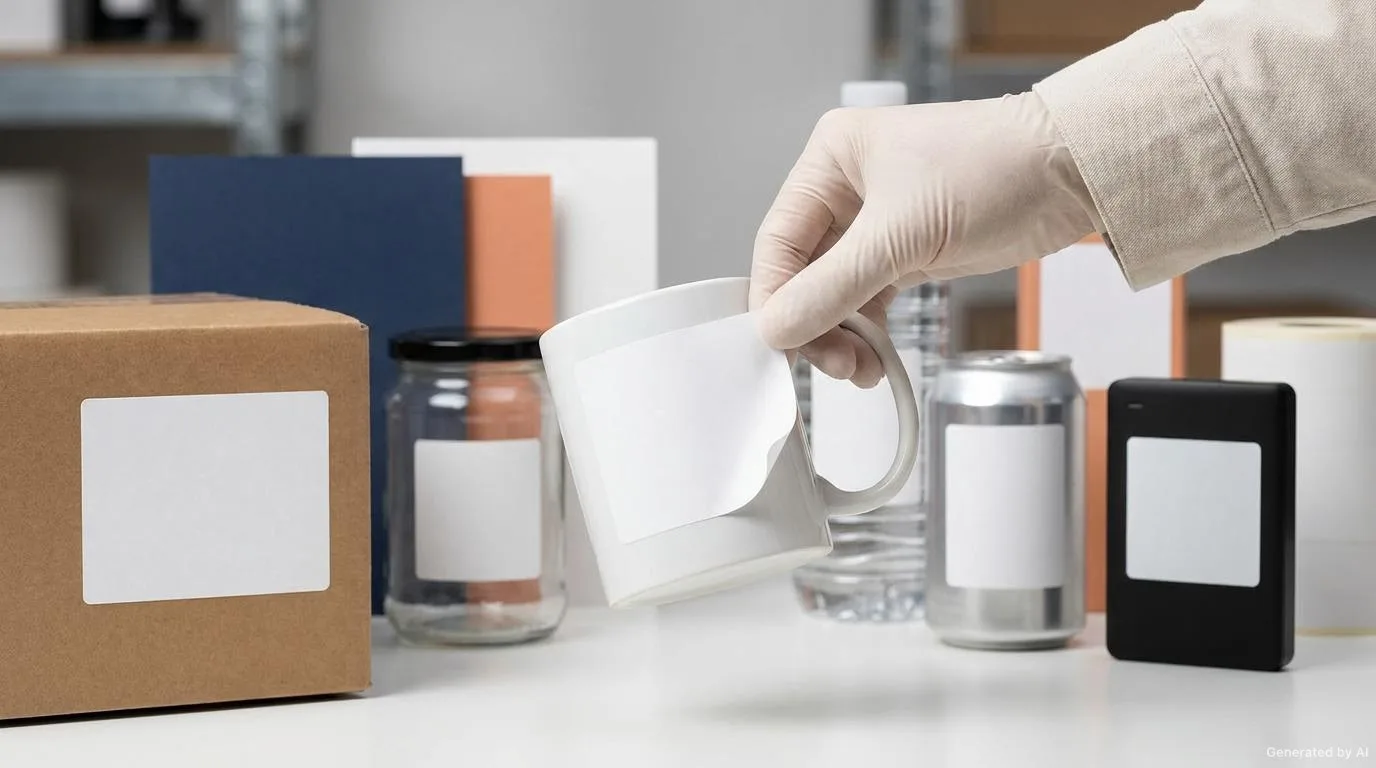
Removable adhesives can be taken off the surface by hand when needed and, ideally, leave no residue. Their holding power is lower than a permanent adhesive, but they can still stay in place throughout the shelf life. For a removable adhesive, coming off easily and falling off by itself are different things; a good removable label stays in place during normal transport and use and only comes off when deliberately pulled.
Removable labels are generally used for temporary information, promotions and campaigns, price and discount marking, events, and safety and hygiene notes. Glass packaging, jars, bottles, shop windows and boxes are surfaces where removability matters most. Rental and campaign labels, automotive glass and window applications also fall into this group.
Repositionable (re-stick) labels
Repositionable adhesives can be lifted after application and applied again to the same or a different surface. This behaviour allows correction when a label is misaligned or placed in the wrong position. It is a great convenience when the label position changes often on a packaging line or when labels are applied by hand.
Repositionable adhesives are typically found on note labels, temporary numbering, promotion and event wristbands, temporary wayfinding, and education and stationery applications. The adhesion level is deliberately kept medium, so it may not be enough on its own for heavy, rough or damp surfaces.
Residue-free (ultra-removable) labels
In some applications the label must leave no mark, adhesive residue or shadow at all after removal. These labels, often called ultra-removable or residue-free, are preferred especially on high-value or visible surfaces, such as glass, mirrors, electronic device housings, furniture, shop windows and product faces shown directly to consumers. Residue is a problem both for appearance and for cleaning cost, and cleaning methods that scratch or dull the surface may be required.
The success of a residue-free label is directly linked to how smooth and clean the surface is. On porous, textured or soiled surfaces, no adhesive may behave perfectly residue-free. So when selecting this type of label, the surface must always be taken into account.
Cold environment and freeze adhesives
Cold-environment adhesives retain their bonding ability at low temperatures. There are two different scenarios: applying the label to a cold surface, and the label entering the cold after application. These are different requirements, so the application temperature and service temperature stated by the manufacturer should be read separately.
Freeze adhesives are used for frozen products and across the cold chain. Because an adhesive stiffens at low temperature and cannot wet the surface properly, a specially formulated adhesive is needed. These labels appear on frozen food, iced beverages, chilled packs and cold-store applications. For more on cold chain, moisture and condensation, see our article on label selection for cold chain products.
High-tack adhesives
High-tack adhesives are designed to achieve adhesion especially on difficult surfaces, meaning rough, slightly damp, dusty, textured or low-surface-energy materials. High initial tack means the label grips immediately and does not slide. These adhesives can be permanent, but high tack and permanence are not the same concept. An adhesive can hold extremely strongly and still come off cleanly; that depends entirely on the formulation.
High-tack adhesives are generally used on heavy products, outdoor labels, recycled paper and board (textured surfaces), low-surface-energy plastics such as polyethylene and polypropylene, and transport conditions. A general framework for demanding conditions is covered in our article on industrial labels.
Adhesive type comparison table
The table below compares label types by adhesive behaviour at a general level. The assessment covers typical conditions; the real result may vary with surface, temperature and application.
| Adhesive type | General holding power | Removability | Residue risk | Typical use |
|---|---|---|---|---|
| Permanent | High | Difficult; usually leaves residue | High | Product and statutory labels, logistics |
| Removable | Medium | Easy; removed by hand | Variable | Promotion, campaigns, temporary info |
| Repositionable | Medium-low | Very easy; can be re-applied | Low-medium | Notes and events, temporary numbering |
| Residue-free (ultra-removable) | Medium | Easy; residue-free removal targeted | Very low | Glass, electronics, windows, high-value surfaces |
| Cold / freeze | Condition-dependent | Product-dependent | Product-dependent | Frozen and chilled food, cold storage |
| High-tack | Very high | Product-dependent | Usually high | Difficult surfaces, heavy products, outdoors |
How surface and temperature affect adhesive behaviour
The performance of an adhesive depends not only on its own properties but also on the properties of the surface and the environment. Adhesion is determined by surface energy, roughness, cleanliness, moisture and temperature. On smooth, high-surface-energy surfaces (such as glass and some rigid plastics) the adhesive wets easily and bonds well; on rough or low-surface-energy surfaces, adhesion becomes harder.
Temperature changes the viscoelastic behaviour of the adhesive. In the cold the adhesive stiffens and its wetting ability drops; in the heat it becomes more fluid and grips faster, though at very high temperatures the shear risk can increase. Moisture disrupts contact because a thin film of water sits between adhesive and surface. Surface and temperature are therefore as decisive as the adhesive type itself. For the basics of choosing an adhesive by surface and use conditions, see our article on how to choose a label adhesive.
Residue risk and storage
Residue is the adhesive mark left on the surface after a label is removed. Residue risk depends on the adhesive type, the smoothness of the surface, how long the label stays on it, and temperature. A permanent adhesive left for a long time under sun and heat can leave far more residue when removed; the same adhesive applied for a short time may come off more cleanly. This shows that removability is a concept tied to time and conditions.
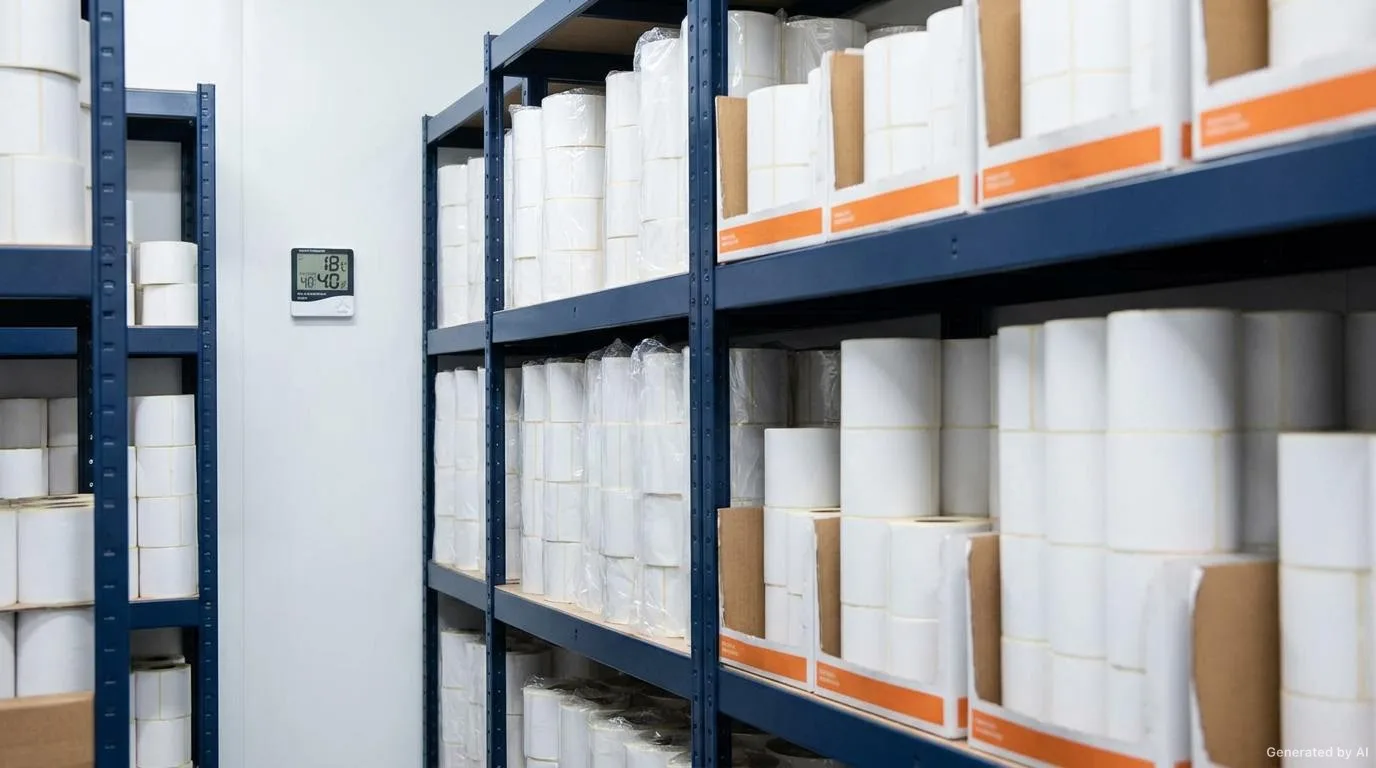
Storage also affects performance. Label rolls should be kept within the temperature and humidity range recommended by the manufacturer and away from direct sunlight and damp floors. A roll stored in extreme heat or cold may not behave as expected during application. Especially with removable and residue-free products, storage conditions directly affect removal behaviour.
Selection criteria
A common confusion: removable or permanent?
The most common mistake is deciding with only hold well or come off easily. The right questions are:
- Will the label stay for the product's whole life, or be removed at some point?
- Is residue acceptable when removed, or is a clean removal essential?
- Is the surface smooth or textured; high or low surface energy?
- What are the application and use temperatures; will it be applied to a cold surface?
- How long will the label stay on the surface; will it be exposed to sun, moisture or abrasion?
- Will it be applied by hand or by machine?
The answers clarify whether a permanent, removable, repositionable, residue-free, cold or high-tack class fits best. For the overall selection framework, our label selection guide is a good starting point.
Checklist
- Will the label be removed later?
- Is residue acceptable?
- Is the surface smooth or textured, high or low surface energy?
- Is the surface clean, dry and free of oil?
- Are the application and service temperature ranges defined?
- Will the product enter the cold chain?
- Is barcode or QR code readability critical?
- Has the time the label will stay on the surface been estimated?
- Will it be applied by hand or by machine?
- Has a sample been tested under real conditions?
- Is food-contact suitability required and confirmed?
- Are roll storage conditions planned?
Realistic scenario: returnable glass packaging and a promo label
A beverage producer uses two different labels on the glass bottles it sells: a permanent product label and a removable promo label that says new flavour. When the promotion ends, the label must come off without residue and the product barcode must stay intact. Because the first trial used a permanent adhesive for the promo label, a clear mark was left on the bottle when removed, requiring extra cleaning on the filling line.
In the sample study the producer tested a residue-free (ultra-removable) adhesive for the glass surface. The promo label now comes off easily by hand with no mark on the surface, while the permanent product label stays intact throughout the shelf life. The producer also confirmed that the barcodes of both labels remain readable after removal. This example shows that different adhesive classes should be chosen deliberately for different jobs on the same product. For packaging and shelf interaction, see label selection for food products and, for a material comparison, coated paper vs film labels.
Conclusion and recommendations
The choice between removable and permanent labels is a decision that is often overlooked but directly affects cost and customer experience. A permanent adhesive suits staying with the product, a removable adhesive suits later removal, and a repositionable adhesive suits correction and re-positioning. The residue-free, cold and high-tack classes each answer specific challenges. The way to make the right decision is to define the job, take surface and temperature into account, and test with a sample.
To review our label solutions, visit our products page, and for more detail on material and adhesive selection, browse the guides on our blog.
Let's plan the right solution together
If you want to determine the right adhesive class for your product, decide whether it should be permanent or removable, and see real performance on a sample, simply share your requirement. Request a quote and our team will plan the most suitable label solution for your product together with you.
Frequently Asked Questions
What is the main difference between a removable and a permanent label?
The main difference is holding power and removal behaviour. A permanent label bonds strongly to the surface and usually leaves residue or tears when removed; a removable label stays in place during normal use and comes off only when deliberately pulled.
Does a removable label fall off by itself?
No. A good removable label stays in place during normal transport and use; coming off easily and falling off by itself are different things. The label separates from the surface only when deliberately pulled.
Does a residue-free label come off cleanly on every surface?
Not always. The success of a residue-free label depends on how smooth and clean the surface is; on porous, textured or soiled surfaces no adhesive may behave perfectly residue-free. The surface must always be taken into account.
Why is applying a label to a cold surface different from the label entering the cold afterwards?
They are different requirements. For application to a cold surface, the adhesive must wet at low temperature; when entering the cold afterwards, application happens at normal temperature and adhesion must be preserved in the cold. So the manufacturer's application and service temperature data should be read separately.
Is a high-tack adhesive the same as a permanent one?
No. High tack and permanence are different concepts. An adhesive can hold very strongly and still come off cleanly; this depends entirely on the formulation. High tack is used especially to achieve adhesion on difficult surfaces.
Want to Determine the Right Label for Your Product?
Share your usage area and needs with us; let's evaluate suitable options together.