Label Selection for Cold Chain Products
We examine label selection for frozen, chilled and iced products through low-temperature adhesive behaviour, application to wet and frozen surfaces, material choice, moisture conditions and barcode readability.
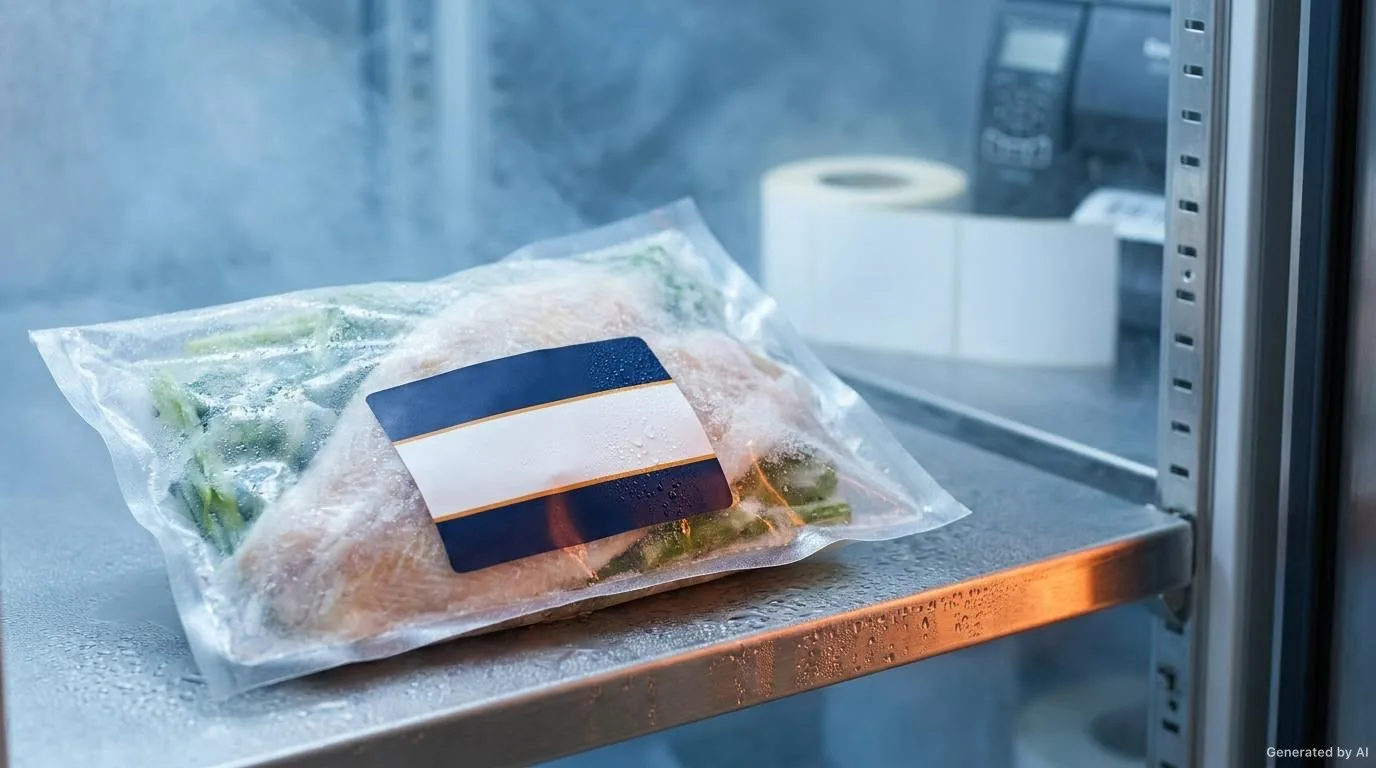
The cold chain requires frozen, chilled and iced products to be kept within a certain temperature range from production to the consumer. Within that flow, the label both carries product information and must withstand demanding conditions such as the refrigerator, freezer, cold store and transport. Low temperature, condensation, moisture and ice can directly affect how an ordinary label adheres and how readable it stays. In this article we examine label selection for cold chain products through adhesive behaviour, surface conditions, material choice and readability.
Short answer: when choosing a label for the cold chain, do not look only at the product name. Look at the lowest temperature the product will encounter before reaching the consumer, the surface temperature and moisture at the moment of application, whether the surface is smooth or textured, and how long it will stay on the shelf. The right combination can vary with the product type, packaging and target market, so testing with a sample is the safest path.
What is the cold chain and why does it matter for labels?
The cold chain is the transport of a product through temperature-controlled environments (chilled, frozen or iced) from the production facility to distribution, storage and the point of sale on the shelf. As long as this chain is unbroken, product quality and safety are preserved. The label is a silent part of this chain: it carries the product identity, batch information, expiry date and barcode.
In the cold chain the conditions a label faces differ markedly from normal shelf conditions. The label is applied to a cold surface, becomes damp through condensation and spends hours or days on moist and frozen surfaces. An ordinary label that performs flawlessly at room temperature can therefore lift at the corners or become unreadable in the cold.
The key point is this: in the cold chain, failure usually appears not as "the label does not stick" but as "edge lift, blistering or slipping". This distinction explains why the right material and adhesive choice is critical. For a general material framework, our article on labels resistant to water, moisture and outdoor conditions can be a useful guide.
Adhesive behaviour at low temperature
Adhesives are materials whose character changes with temperature. On a cold surface the adhesive's ability to wet the surface decreases; the adhesive stiffens and cannot penetrate the surface sufficiently. As a result, initial tack drops and the label may begin to lift from its edges.
That is why cold chain applications prefer what are called "cold-temperature adhesives", which keep their adhesion at low temperatures. These adhesives are chosen for one of two different conditions: the label is applied to a cold surface, or the label goes into the cold after being applied. These are different requirements and should be assessed separately on a sample.
How to choose a cold-temperature adhesive?
The aim is for the adhesive to keep working both at the moment of application and at the temperature the product will see afterwards. The manufacturer's stated application temperature range and service temperature range should be read separately, because an adhesive may grip well in the cold while behaving differently once the label enters the cold after application.
These values vary by product type and manufacturer, so rather than giving an exact number it is correct to make the choice according to your real application conditions. Whether the label is applied to a cold and wet surface or first to a normal surface also affects this decision.
The effect of application temperature: The surface temperature at the moment of application is one of the most important variables determining adhesion quality. A label applied to a very cold surface cannot make full contact because the adhesive cannot wet the surface. In addition, if pressure and contact time are insufficient in a cold environment, the label's adhesion may be delayed.
It is therefore recommended that the label be pressed firmly onto the surface and that work be carried out at a suitable ambient temperature. This point is even more important in small-scale production with manual application.
Holding power in the cold and edge lift: When the label enters the cold after application, the tension between the adhesive and the surface can increase. Edge lift is a typical problem, especially on flexible packaging and narrow labels. To reduce edge lift, an adhesive that seats well on the surface should be chosen, the surface should be clean and dry, and edge tolerances should be planned correctly where needed.
Application to wet, condensed and frozen surfaces
The most common challenge in the cold chain is applying a label to a wet or icy surface. Condensation appears as a thin film of water that forms on the surface when the product is taken out of the cold cabinet. This film slips between adhesive and surface, reducing the contact area.
Adhesion behaviour can change on moist and oily surfaces; the adhesive and material chosen for these conditions may differ from those for normal conditions. On frozen surfaces, the water turning solid makes the surface even more slippery and uneven. Adhesion becomes harder, and the water formed as the ice melts can affect adhesion again.
- Keep the surface as clean and dry as possible.
- Apply the label before an ice layer forms.
- Press the label firmly onto the surface during application.
- Test the surface, temperature and moisture conditions in the real environment.
In practice, the most reliable approach is to keep the surface as clean and dry as possible, to apply the label before an ice layer forms, and to test with a sample under real conditions. For the general framework of label selection by packaging type, see our article on label selection for food products.
Material choice: thermal, film and PP/PE
In the cold chain, the material determines how the label behaves against moisture, temperature change and friction. Roughly two groups stand out: paper-based faces (mostly thermal) and film-based faces.
Thermal and paper-based labels
Direct thermal labels receive their print through a heat-sensitive coating without a ribbon. They are economical and practical, but because of their sensitivity to moisture, water and friction they may not always be ideal on their own in cold and wet environments. Condensation and a damp environment can speed up fading or scuffing of thermal print.
Solutions supported by a protective film (lamination or a top coating), on the other hand, can be more durable in damp conditions. We cover the differences between thermal and other printing methods in our article on thermal transfer and direct thermal printing.
Film labels and PP/PE faces
Film labels (for example PP- and PE-based faces) are generally more resistant to moisture and water than paper. They are therefore frequently preferred in the cold chain, on wet and condensed surfaces. Synthetic faces are also more resistant to tearing, though their flexibility and conformity to the surface vary by material type.
PP (polypropylene) films typically stand out for their balance of stiffness, clarity and moisture resistance, while PE (polyethylene) films offer a softer and more flexible structure. PE is often preferred on flexible packaging and PP on rigid, flat surfaces. The right choice depends on the packaging shape and application conditions. For a comparison of materials, our article on coated paper and film label comparison will be helpful.
Moisture, ice and condensation conditions
Moisture and ice are two fundamental factors determining a label's life in the cold chain. Constant condensation can cause waving and edge lift on paper-based labels. Film labels are more resistant here, but freeze-thaw cycles can also harm the adhesive.
What matters in these conditions is that the label preserves both its adhesion to the surface and its readability. In damp environments ink can spread or fade, so the print and top coating must be compatible with moisture. For readability on an icy surface, contrast-rich design and the right material should be assessed together.
Barcode readability: in the refrigerator and freezer
In the cold chain, barcodes are critical not only for the till but also for storage, shipping and traceability. However, refrigerator and freezer conditions can make barcode readability harder. The reasons include moisture, icing, fading, wrinkling and low contrast.
To preserve readability, the barcode should be printed at sufficient size and contrast, the surface and adhesive should support readability, and the print should be resistant to moisture and friction. Especially in the freezer, paper labels waving from moisture can break the barcode; film labels and protective coatings can reduce this risk. For broader information on barcode selection and printing, see our article on barcode labels.
Product/condition, material and adhesive suitability table
The table below gives general guidance for common products and conditions in the cold chain. The assessment is for typical conditions; results may vary in specific applications and sample testing is recommended.
| Product / condition | Suitable material (general) | Adhesive direction |
|---|---|---|
| Frozen food (flexible packaging) | Film, PE- or PP-based | Cold adhesive that holds at low temperature |
| Chilled packaged meat / dairy | Film or film-coated face | Moisture-resistant adhesive |
| Iced / frozen surface | Film label | Adhesive suited to frozen and wet surfaces |
| Dry cold store (packaged goods) | Paper or film | Adhesive that holds in the cold |
| Logistics / carton barcode (cold) | Film with protective coating | High initial tack, moisture resistance |
| Refrigerator shelf label (short term) | Paper or film | General purpose, watch moisture resistance |
Application, storage and transport
In the cold chain a label's performance is determined not only by the material but also by the moment of application and the processes that follow. The label roll should be stored under suitable conditions before application; a roll kept in an excessively cold or damp environment may not behave as expected during application.
During application, keeping the surface clean, dry and, where possible, close to room temperature makes adhesion easier. Pressing the label evenly onto the surface, leaving no air pockets and ensuring the edges stick well all matter. During transport, friction, stacking and vibration can fatigue the label edges, so packing and stacking arrangements affect label life.
For storage, label rolls should be kept in the manufacturer's recommended conditions and away from direct sunlight. Protecting unused rolls from contact with damp floors and not leaving them in the open preserves application quality.
Food safety and contact suitability
For labels used on food packaging, the contact situation of the material and adhesive with the product should be considered. The label is usually applied to the outer surface of the packaging, but in some applications direct contact with the product may occur. The material and adhesive chosen should therefore be assessed for food contact suitability and under the relevant regulations of the target market.
Suitability can vary with the product type, the form of contact and the regulations in force. Rather than giving a specific standard or clause number, the most correct approach is to request up-to-date suitability information from the supplier and confirm the necessary documents. Food contact suitability should be planned early in the label design and material selection process.
Checklist
- What is the lowest temperature the product will be exposed to before reaching the consumer?
- Will the label be applied to a cold surface, or to a normal surface and then enter the cold?
- Can the surface be wet, condensed or icy?
- Is the packaging surface smooth, or textured and flexible?
- Is the material suited to moisture and condensation (were film-based options considered)?
- Does the adhesive support adhesion at low temperature?
- Will the barcode stay readable in freezer and refrigerator conditions?
- Has food contact suitability been confirmed for the target market?
- Was sample testing done under real conditions?
- Are roll storage and application conditions planned?
Realistic scenario: a frozen food manufacturer
A mid-sized frozen vegetable manufacturer packs its products in flexible plastic pouches. The products are frozen quickly after production, and the labels are applied to the pouches before they enter the freezer. With its existing paper labels the manufacturer is experiencing edge lift after freezing and waving caused by moisture, and also notices that some barcodes are not read on the warehouse side.
In a sample study the manufacturer tests a combination of a film-based face and a cold-temperature adhesive. With the new combination the label edges hold better and the barcodes are read more reliably in freezer conditions. The manufacturer takes care that the pouch surface is dry and clean before application and applies the label before freezing. This example shows that success in the cold chain depends on planning the material, the adhesive and the application sequence together.
Conclusion and recommendations
Label selection for cold chain products requires a different way of thinking than ordinary shelf conditions. Adhesive behaviour at low temperature, application to wet and frozen surfaces, moisture and ice conditions, material choice and barcode readability should all be assessed together. The most reliable way to determine the right combination is a sample test that reflects real conditions.
In short, three questions are decisive: What is the lowest temperature the product is exposed to? Is the label applied to a wet, icy or flexible surface? Is barcode readability critical? The answers clarify the material and adhesive choice. To review our label solutions, you can visit our products page. For details on adhesive selection, our article on how to choose a label adhesive will also help.
Let us plan the right solution for your needs together
If you want to determine the material and adhesive suited to your product's cold chain conditions and see real performance on a sample, simply share your requirements. Request a quote and let our team plan the most suitable label solution for your product together with you.
Frequently Asked Questions
Which adhesive should be used for the cold chain?
It depends on whether the label is applied to a cold surface or enters the cold after application. Cold-temperature adhesives that hold at low temperature are preferred; the application and service temperature ranges should be checked separately in the manufacturer's information and tested on a sample under real conditions.
Will a label stick to a frozen surface?
With the right material and adhesive, application to a frozen or wet surface is possible, though adhesion is harder than under normal conditions. The surface should be clean and, where possible, free of an ice layer, and a sample test under real conditions is recommended.
In the cold, should paper or film labels be preferred?
In cold conditions with heavy moisture and condensation, film-based labels are generally more durable. Paper can be used for short-term and dry cold applications. The choice depends on the moisture level and the duration of use.
Why are barcodes unreadable in the refrigerator and freezer?
Moisture, icing, fading, wrinkling and low contrast can reduce readability. Sufficient print size and contrast, a moisture-resistant material and a suitable adhesive improve readability.
What should be considered when choosing a label for food contact?
The food contact suitability of the material and adhesive in the target market should be confirmed. Because suitability can vary with the product type and the regulations in force, up-to-date information should be requested from the supplier and the necessary documents confirmed.
Want to Determine the Right Label for Your Product?
Share your usage area and needs with us; let's evaluate suitable options together.