How Is Label Printing Cost Calculated?
Label printing cost combines material, printing, plate, coating and waste items. This guide explains the unit-cost formula, the volume-to-unit-cost relationship and an illustrative calculation example.
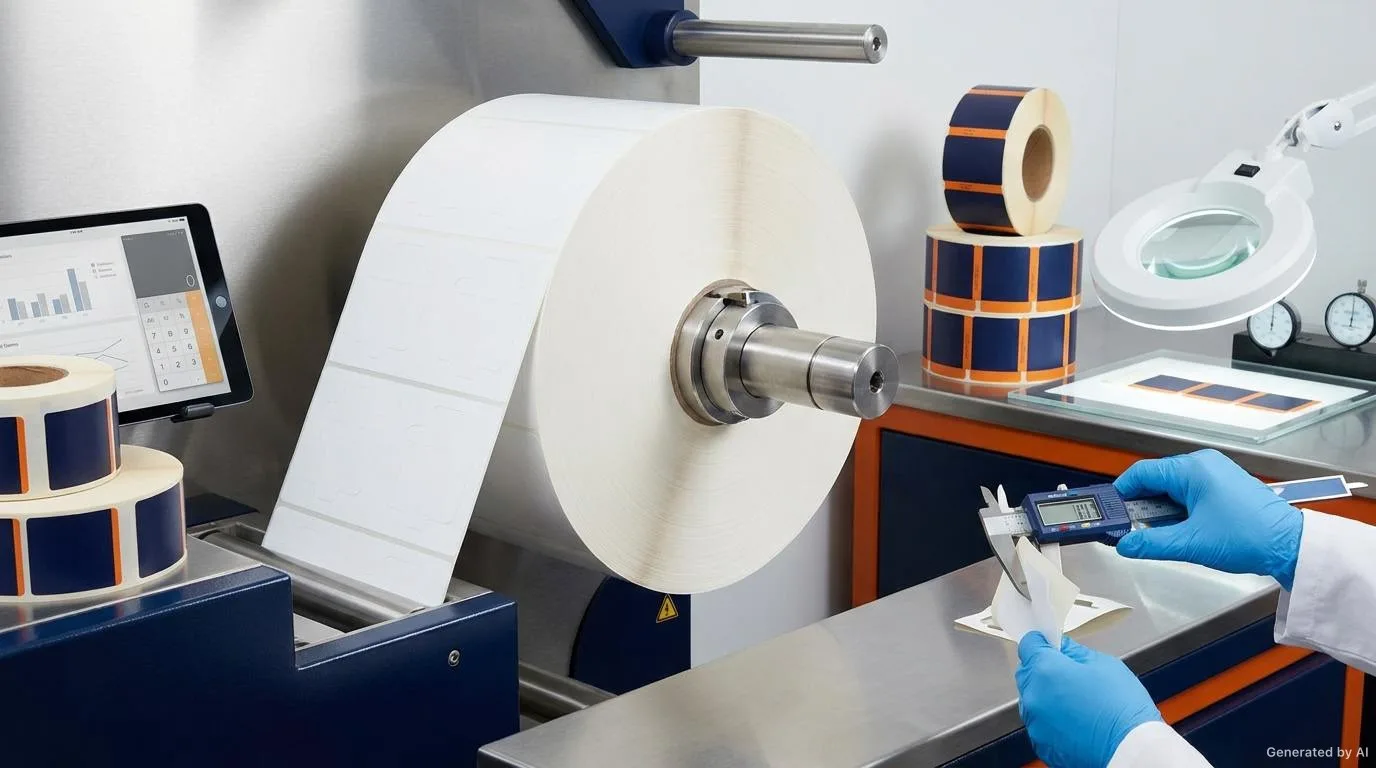
Label printing cost is not a single price per label; it is the sum of material, adhesive and liner, printing, varnish and coating, plate and setup expenses, plus a waste allowance. To calculate it correctly, the total expense must be divided by the order quantity, because a label's unit cost drops noticeably as volume grows. This guide explains, step by step, how label printing cost is calculated, which items feed into the unit cost, and how the calculation is built using an illustrative example.
What Makes Up Label Printing Cost?
Label printing cost is the sum of several interdependent items. These are, in general: face material, adhesive and liner, printing, surface treatments such as varnish and coating, plate and press setup, waste, and finally overhead plus margin.
Some of these items stay fixed regardless of order quantity, while others grow in proportion to volume. Making this distinction up front is essential, because unit cost depends mainly on how many labels the fixed expenses are divided across.
Cost Components in Detail
- Face material: paper, film or special stock; calculated from cost per square metre and multiplied by total label area.
- Adhesive and liner: usually supplied as ready self-adhesive stock, so it is included within the material cost.
- Printing: depends on the number of colours, the printing technology and ink consumption.
- Varnish and coating: matt or gloss varnish, lamination and similar protective or decorative treatments.
- Plate and setup: cutting die, printing plate, machine adjustment and test runs.
- Waste: the share of labels lost during setup, cutting and rewinding.
- Overhead and margin: labour, energy, packing, transport and manufacturer margin.
How Is Unit Cost Calculated? The Basic Formula
The general approach can be summarised in a single formula: Unit Cost = (Total Fixed Cost + Total Variable Cost) ÷ Net Usable Quantity.
Here, net usable quantity means the number of labels that can be delivered to the customer after waste is deducted from the total produced. Variable costs are items that grow with volume, such as material and ink; fixed costs are items such as plate and setup that stay the same whatever the quantity.
The Variables in the Formula
- Total label area (square metres)
- Material cost per unit area
- Colour and print count, plus coating layers
- Plate and setup fixed amount
- Waste rate
- Overhead and margin contribution
Fixed and Variable Costs: The Effect of Volume
The index values in the table below are illustrative; the aim is to show how the share of fixed costs shrinks as volume grows. Real ratios vary with material, printing and labour structure.
| Order quantity | Unit cost index (illustrative) | Explanation |
|---|---|---|
| 1,000 | About 180 | Plate and setup cost is divided across few labels; unit cost is high. |
| 5,000 | About 130 | The share of fixed costs drops noticeably. |
| 10,000 | About 110 | Material and printing efficiency come to the fore. |
| 25,000 | About 100 | Can be taken as a reference level. |
| 50,000 | About 95 | The marginal decline slows; setup is now spread over many labels. |
The logic is simple: the setup expense that dominates at low volume is spread across many labels as volume rises, and unit cost falls. This decline is not endless, however; beyond a certain quantity, variable items such as material and labour become dominant and the curve flattens.
Plate and Press Setup Costs
The cutting die and press setup are one-off expenses that arise independently of order quantity. For this reason they are the items that raise unit cost most in small orders. When the same die is reused, for example on a repeat order, this expense either disappears or falls sharply, which noticeably improves the unit cost of recurring orders.
Press setup also includes machine adjustment, colour matching and test runs. These items are fixed per job; the larger the job, the smaller their share per label. Ignoring plate cost leads to a serious deviation in quotes for small quantities.
Material, Adhesive and Liner Cost
Material is usually the largest part of total cost. Questions such as whether the label face will be paper or film, whether the adhesive is permanent or removable, and which liner type is used directly determine the cost per square metre. Material choice should consider not only price but also durability, print quality and application suitability.
Our article Technical Questions to Ask When Choosing Label Material is a useful guide while working on this cost item. The right material reduces both unnecessary cost and hidden waste.
Printing, Varnish and Coating Cost
Printing cost relates to the number of colours, the printing technology and the run length. Multi-colour and full-coverage work requires more ink and more setup. Coatings such as matt or gloss varnish and lamination improve both visual quality and durability, but every additional layer adds to cost.
If an unnecessary coating raises cost without adding practical benefit, this item should be reviewed. Conversely, on a label used in harsh conditions, the absence of a protective coating can create re-labelling costs later.
How Is the Waste Allowance Accounted For?
No print job is completed without waste. A certain proportion of labels is lost during machine setup, colour changes, cutting and rewinding. A correct calculation requires adding a waste allowance on top of the desired net quantity: Total Production Quantity = Desired Net Quantity × (1 + Waste Rate).
The waste rate varies with job complexity, printing technology and machine setup time, and it usually decreases on a repeat job. Ignoring waste leads to a shortage at the end of the order or to later top-up costs.
An Illustrative Calculation Scenario
The table below is an illustrative framework for showing how items feed into unit cost. No exact amount is given; the aim is to demonstrate the logic of the calculation.
| Cost item | Type | Behaviour as volume rises |
|---|---|---|
| Face material | Variable | Rises in proportion to quantity. |
| Adhesive and liner | Variable | Rises with the material. |
| Printing and ink | Partly variable | Rises with colours and run length; setup is fixed. |
| Varnish and coating | Variable | Rises with the coated area. |
| Plate | Fixed | One-off, independent of quantity. |
| Press setup | Fixed | Fixed per job. |
| Waste | Ratio | Added in proportion to net quantity. |
| Overhead and margin | Ratio | Usually added as a percentage of the total. |
To build a calculation, work through total area, variable costs, fixed costs and the waste allowance in order, then divide the total by the net quantity. This approach answers the question of why this price item by item.
A Practical Checklist
You can follow these steps when requesting a quote or working out your own cost:
- Are the label dimensions and the net quantity to be delivered defined?
- Are the material type, adhesive type and liner clear?
- Are the number of colours and the printing technology decided?
- Is the varnish or coating genuinely necessary?
- Will the plate be reused, or must a new one be produced?
- Has the waste rate been taken into account?
- Are packing and delivery terms included in the price?
- Have overhead and margin been added to the item?
A Realistic Use Scenario
A small food business plans to order self-adhesive labels in specific dimensions. On the first order, because a new cutting die must be produced, the plate and setup expenses are a one-off, noticeable burden; consequently the unit cost is high on the initial purchase. When the business orders the same label again three months later, the die is already available, so that expense disappears and the unit cost falls.
Likewise, ordering the full requirement at once in a slightly higher quantity instead of a small test run allows the plate and setup cost to be spread over more labels. This scenario clearly shows the effect of order planning on cost.
Ways to Reduce Cost
Reducing cost does not always mean choosing the cheapest material; the right balance matters.
- Increase the quantity so fixed costs are spread over more units.
- Place repeat orders so the plate can be reused.
- Avoid unnecessary coatings and excess colours.
- Choose efficient dimensions to reduce material waste.
- Prefer a printing and cutting setup that lowers the waste rate.
- Clarify packing and delivery terms from the outset.
- Prepare the artwork for print to reduce the need for test runs.
Conclusion and Actionable Recommendations
Label printing cost is the result of a calculation in which material, printing, plate, coating and waste items are correctly summed and divided by the net quantity. For a broader view of the factors that affect cost, see our article Factors Affecting Label Cost; for pre-order checkpoints, see Things to Know Before Ordering Roll Labels; and for the right product choice, see Label Selection Guide. You can browse our options on the products page.
A Quote Tailored to You
If you would like a transparent, item-by-item cost breakdown and a clear quote for your own labelling needs, simply share your dimensions, quantity, material and usage details. Our team will evaluate a suitable solution and cost structure and get back to you. Click here to request a quote.
Frequently Asked Questions
Which item affects label printing cost the most?
On high-volume jobs, material is usually decisive; on low-volume jobs, the one-off plate and setup expenses dominate. Which item leads therefore depends on the order quantity and the nature of the job.
Why is unit cost high at low quantities?
Fixed expenses such as the plate and press setup are divided across few labels, so the share per label rises. As quantity grows, the same expense is spread over more labels and unit cost falls.
What happens if the waste allowance is ignored?
The quantity to be delivered may fall short at the end of the order, or a top-up order may be needed later, creating both extra cost and lost time. A waste allowance should therefore be added on top of the desired net quantity.
Why is it more economical to reorder the same label?
The cutting die and press setup are largely one-off expenses. On a repeat order these items either do not arise at all or fall sharply, so unit cost drops noticeably.
Is the most expensive material always the right choice?
No. What matters is that the material suits the usage conditions, the surface and the product's lifetime. A material chosen to match the conditions reduces unnecessary cost and hidden waste.
Want to Determine the Right Label for Your Product?
Share your usage area and needs with us; let's evaluate suitable options together.