Thermal Label or Coated Label? Differences and Applications
Working principles, advantages, limitations and suitable applications of thermal and coated labels. Direct thermal vs thermal transfer difference, comparison table and a decision-making checklist.
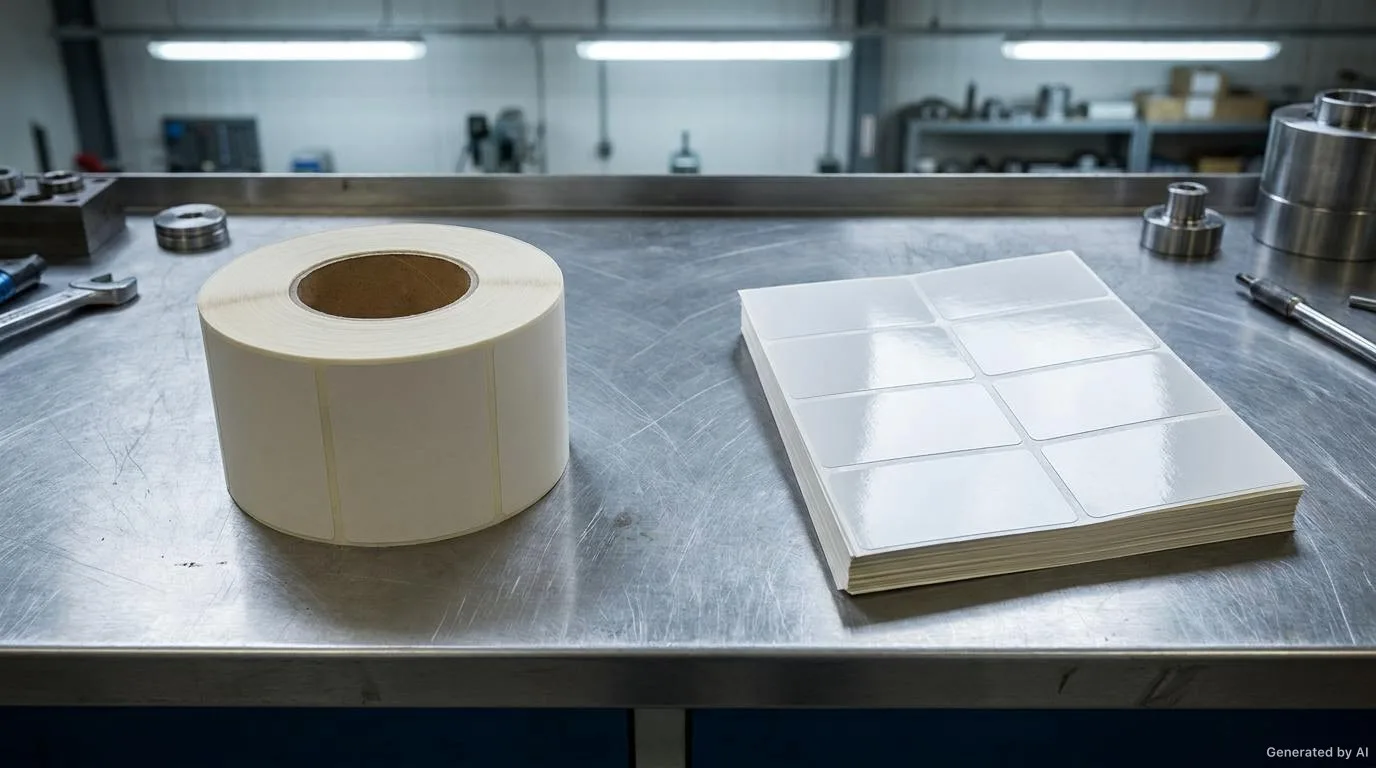
One of the most common questions in label production is choosing between thermal and coated labels. Both technologies serve different needs and cannot be used interchangeably. In this article, we will compare the working principles, advantages, limitations and application areas of thermal and coated labels, and examine with examples which one is more suitable in which situation.
What is a Thermal Label and How Does It Work?
Thermal labels are made of paper or film materials with a special heat-sensitive coating. Printing is achieved when the heated print head of thermal printers activates the color-changing coating on the material. There are two basic thermal printing methods:
Direct Thermal
Uses heat-sensitive coated paper. The print head contacts the paper directly and causes a color change. No ink or ribbon required. This method is fast and economical; however, prints are sensitive to sunlight, heat and friction. It is therefore widely preferred for short-life labels.
Thermal Transfer
Uses a heat-sensitive ribbon. The print head heats the ribbon to transfer ink to the label material. More durable prints are obtained and different colored ribbons can be used. We examined the working logic of this method in detail in our article on thermal transfer and direct thermal printing.
What is a Coated Label and How Does It Work?
Coated labels are made of paper materials whose surface is coated with special chemicals (coating). The coating process smooths the paper surface and improves print quality. Coated labels are printed using traditional methods such as flexo, offset, digital or screen printing and use ink.
The Structure of Coated Paper
The coating process applies a thin mineral layer to the paper surface, creating a smooth and homogeneous surface. This surface allows the ink to adhere in a more controlled way, so fine lines, small text and color transitions are printed more sharply. Different surface finishes such as glossy, matte and soft touch support brand perception.
Printing Methods Used
Coated labels are produced by flexo, offset, digital or screen printing depending on the quantity and design. In high volumes, flexo and offset become economical, while digital printing stands out for low-volume and variable jobs. For surface and material comparisons, see our article comparing coated paper and film labels.
Types of Thermal Labels: Paper and Film
Thermal labels vary not only by printing method but also by the material used. The right material choice directly affects the label's durability and ease of application.
Thermal Paper Labels
An economical and widely used option. It is suitable for short-life, indoor applications that do not come into much contact with moisture. Warehouse shelf labels and instant price labels are examples of this group.
Thermal Film Labels (BOPP / PET)
More resistant to moisture, friction and low temperatures. It is preferred for cold chain, wet surfaces and applications requiring durability. Film materials also offer long-lasting solutions together with thermal transfer printing.
Printer and Hardware Compatibility
Thermal label selection should be evaluated together with the printer infrastructure. Desktop, mobile and industrial thermal printers offer different print widths and resolutions. Print head resolution, label thickness and roll diameter directly affect the choice. For coated labels, plates and the cutting layout are determined according to the printing method. If printer compatibility is ignored, readability and printing continuity can be negatively affected.
Comparison Table
| Feature | Thermal Label | Coated Label |
|---|---|---|
| Printing method | Direct thermal / thermal transfer | Flexo, offset, digital, screen |
| Ink requirement | None (direct), ribbon (transfer) | Yes |
| Print speed | High | Varies by method |
| Variable data | Suitable (barcode, serial no) | Challenging or requires extra process |
| Sunlight resistance | Low (direct thermal) | Medium-high (with lamination) |
| Moisture resistance | Low (paper), high (film) | Low (paper) |
| Shelf life | Short-medium | Long |
| Unit cost | Low | Medium |
| Setup cost | Low | High (plate, setup) |
Advantages of Thermal Labels
- Fast and easy printing, no ink cartridge or plate required.
- Ideal for variable data (barcode, date, serial number) printing.
- Low setup cost, suitable for small quantities.
- Practical for logistics, warehouse and shipping labels.
Limitations of Thermal Labels
- Direct thermal prints fade over time with sunlight and heat.
- Resistance to moisture and chemicals is low on paper-based materials.
- Not suitable for wide color gamut and high-resolution photo printing.
- Not recommended for products requiring long shelf life.
Advantages of Coated Labels
- High print quality, vivid colors and photo printing possible.
- Offers long shelf life; fade resistance can be increased with lamination.
- Offers different surface finishes (matte, glossy, soft touch).
- Economical in large quantities and provides brand consistency.
Limitations of Coated Labels
- Plate and setup costs are high, expensive for small quantities.
- Variable data printing requires additional processing or digital printing.
- Moisture resistance is limited as it is paper-based.
- Design changes require additional cost and time.
When to Choose Which?
Situations Where Thermal Labels Are Suitable
Logistics labels, barcode labels, shipping labels, short-life products, labels with variable data, low-quantity and fast production requirements.
Situations Where Coated Labels Are Suitable
Long shelf-life food products, cosmetics, household chemicals, products where brand appearance is prominent, high-volume production, multi-color and photo designs.
Hybrid Solutions
Hybrid solutions are also possible. For example, variable data (date, batch no) can be added to a coated label by thermal transfer. To determine the most suitable solution for your production needs, you should evaluate your usage conditions and printing infrastructure.
Real-World Usage Scenarios
Alongside the theoretical comparison, concrete scenarios clarify the choice. The examples below reflect typical production situations.
Scenario 1: Food Producer
Variable data such as the expiry date and batch number is reprinted for every batch. For this reason, thermal solutions, especially thermal transfer, remain fast and flexible. As the product's shelf life increases and the packaging becomes more colorful, coated labels and lamination come into play.
Scenario 2: Cosmetics Brand
Brand perception and visual quality come first. In designs requiring photos, gradients and fine typography, coated labels provide higher print quality. Since variable data is usually limited, a coated solution becomes the dominant choice.
Scenario 3: Logistics and Warehouse
Shipping, barcode and address labels are printed at high speed and are often short-lived. Direct thermal labels offer speed and low cost advantages here.
Decision-Making Checklist
- I determined the expected shelf life of the product.
- I evaluated the light, heat and humidity conditions the label will face.
- I clarified the need for variable data (barcode, date, serial no).
- I defined my print quality and color expectations.
- I considered the production quantity and the likelihood of frequent design changes.
- I compared the balance between cost and durability.
- I requested sample printing where appropriate.
Factors Affecting Cost
When the costs of the two label types are compared directly, quantity, material and printing method are decisive. Thermal labels have low setup costs and offer an advantage for short runs; with coated labels, plate and setup expenses are spread over a larger volume in high quantities, so their impact on unit cost decreases. Print permanence, reprint frequency and losses during application affect the total cost. Therefore, when deciding, it is more accurate to look not only at the unit price but at the total cost of ownership.
Conclusion
Thermal and coated labels serve different needs. The right choice depends on your product's shelf life, printing needs, quantity and budget. By clarifying your usage conditions, you can compare the value both technologies will provide.
If you would like to evaluate together which solution suits your product better, you can review our products and contact us for options that fit your needs.
Frequently Asked Questions
What is the main difference between thermal and coated labels?
Thermal labels print using a heat-sensitive coating, while coated labels are produced with traditional printing methods that use ink. As a result, durability, cost and application areas differ.
What is the difference between direct thermal and thermal transfer?
In direct thermal printing the coating on the paper changes color with heat and no ribbon is needed. In thermal transfer, ink is transferred from a heated ribbon to the label for a more durable print.
When should a coated label be preferred?
Coated labels are more suitable for long shelf-life food, cosmetics and products where brand appearance is prominent, as well as multi-color and photo designs.
Why do thermal labels fade over time?
Direct thermal prints can fade over time due to sunlight, heat and friction. Where long life is required, thermal transfer or lamination is considered.
What is a hybrid solution?
A hybrid solution means adding variable data such as a date or batch number to a coated label by thermal transfer, combining high print quality with variable data.
Want to Determine the Right Label for Your Product?
Share your usage area and needs with us; let's evaluate suitable options together.