Differences Between PP, PE and PET Label Materials
We compare PP, PE and PET film label materials in terms of structure, surface and clarity, durability, temperature and chemical resistance, applications, recycling and cost, and explain which one suits which product.
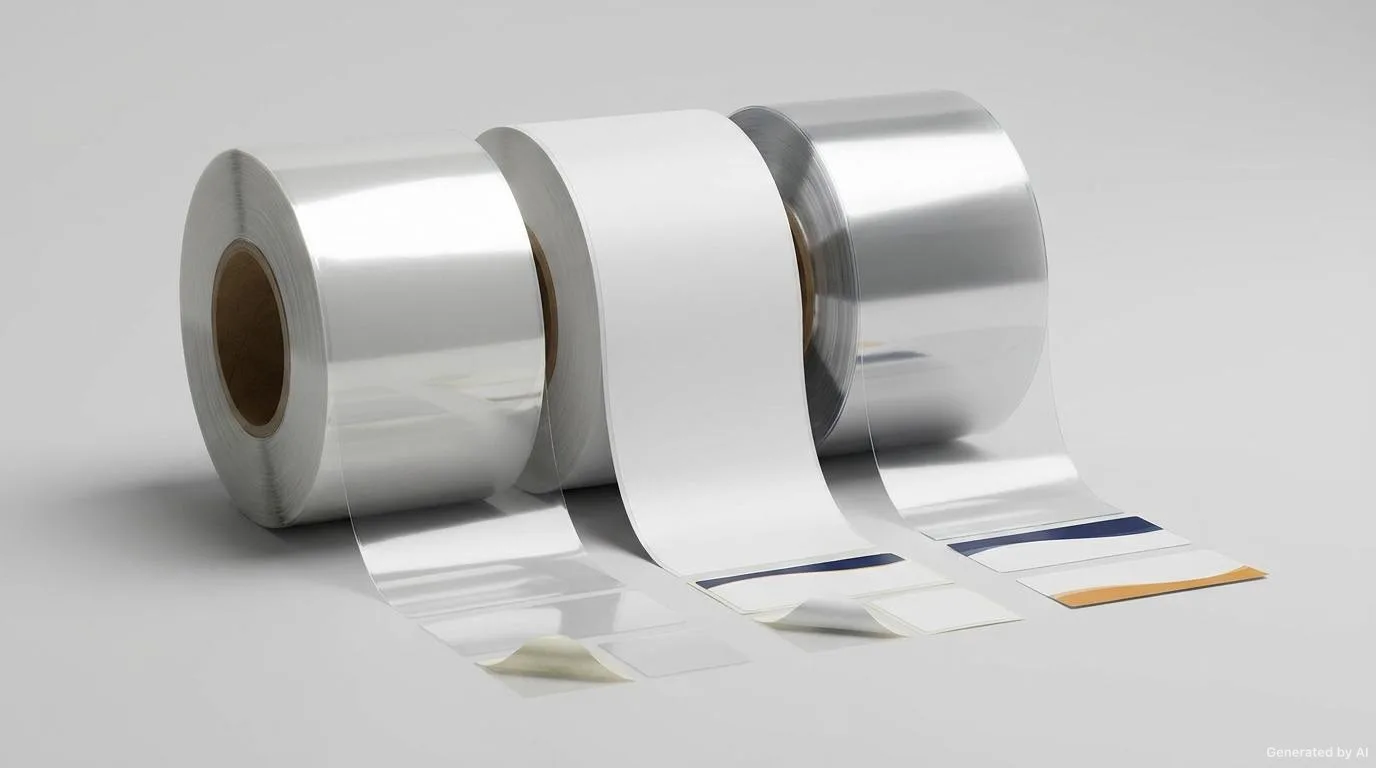
PP, PE and PET are the three most widely used film (plastic) materials in label production. Unlike paper labels, they resist water, moisture and many chemicals better, which makes them a common choice for transparent, durable or weather-exposed products. There is no single answer to “which one is better?” The right choice depends on the product surface, storage and use conditions, the packaging type and the budget.
In this article we compare the three film materials with each other: structural differences, surface and clarity, durability, temperature and chemical resistance, adhesive compatibility, applications, matte and gloss options, recycling and cost. Our goal is to present each material without exaggeration and to give a practical framework for the question “which material for which product”.
What are PP, PE and PET?
All three are polymer-based films—thin, flexible plastic layers. When people talk about a “film material” for a label, they usually mean these synthetic surfaces. The differences between them come from the chemical structure of the polymer and the film production method, which shape the surface appearance, stiffness, flexibility and durability.
PP — polypropylene
In the label world, PP (polypropylene) is mostly used as BOPP (biaxially oriented polypropylene). The orientation process strengthens the film and gives it a smooth, print-friendly surface. PP films are usually produced as gloss-clear or matte white and offer a good strength-to-weight balance. It is the most common film material for labels because it strikes a good balance between print quality, durability and cost.
PE — polyethylene
PE (polyethylene) is a soft film used especially for flexible and squeezable packaging. It conforms well to the surface, so a label can move with a squeezed, bent or slightly deformed package without cracking. It comes in white/opaque or clear forms. Clear PE types are generally not as transparent as PP, but their flexibility and conformability are strong.
PET — polyester
PET (polyethylene terephthalate, commonly called polyester) is the stiffest of the three, with the best dimensional stability and chemical resistance. It offers high clarity and gloss and withstands higher temperatures than PP and PE. Its durability makes it a preferred choice for demanding conditions and long-life applications, although its cost is usually higher.
Structural differences and film properties
The key difference lies in how the film is produced and how the polymer chains are arranged. PP and PET are mostly produced by stretching (orienting), which gives them high strength and a smooth surface. PE is produced to remain softer and more flexible. This structural difference directly affects the stiffness and bending behaviour of the label.
In practice this means: if a stiff, flat surface is wanted, PP or PET are suitable; if the package bends and stretches, PE conforms better. PET is the stiffest and most dimensionally stable of the three, which is why it stands out in heat- and chemical-exposed applications.
Surface, clarity and appearance
Clarity and gloss are the most visible differences when choosing a material. PET offers the highest clarity and a glass-like transparency; it covers the product behind it almost like an invisible layer. Gloss BOPP is also very transparent and glossy, so it is often used for “no-label look” labels. Clear PE can look more matte and slightly milky, so it is not the first choice when full clarity is required.
Matte options also differ by material. Matte white PP and PE display printed text without reflection and with high contrast, which is an advantage when readability matters. PET's glossy surface gives a premium, sharp look. The surface choice determines how the label blends with the product.
Durability, temperature and chemical resistance
In terms of durability, PET is generally the strongest option: it resists tearing, abrasion and dimensional change well. PP is also quite durable and resists tearing well, more than enough for most everyday uses. PE is softer and can be scratched more easily on hard surfaces; its real strength is that it stretches with a bending package without cracking.
Temperature and chemical resistance is where the differences become clearest. PET withstands high temperatures and many chemicals better than PP and PE. PP shows good resistance to moderate heat and many oils and alcohols. PE is generally resistant to chemicals but can soften at high temperature. Exact values depend on the product type, film thickness and adhesive, so testing a sample is recommended for a demanding application.
Adhesive compatibility
The choice of film material also affects the adhesive. Surface energy and smoothness determine how well the adhesive bonds. Oriented PP and PET surfaces are usually smooth and consistent, so they work well with standard adhesives. PE's surface is softer and can have lower surface energy, so the adhesive must be selected carefully. On clear, stiff films, the risk of adhesive oozing from the edge over time should also be assessed according to the material and adhesive.
The surface the label is applied to matters just as much as the film. Rough, sloped, cold or oily surfaces may require a special adhesive regardless of the film. For a good match, the surface type and use conditions should be clarified from the start.
Matte and gloss surface options
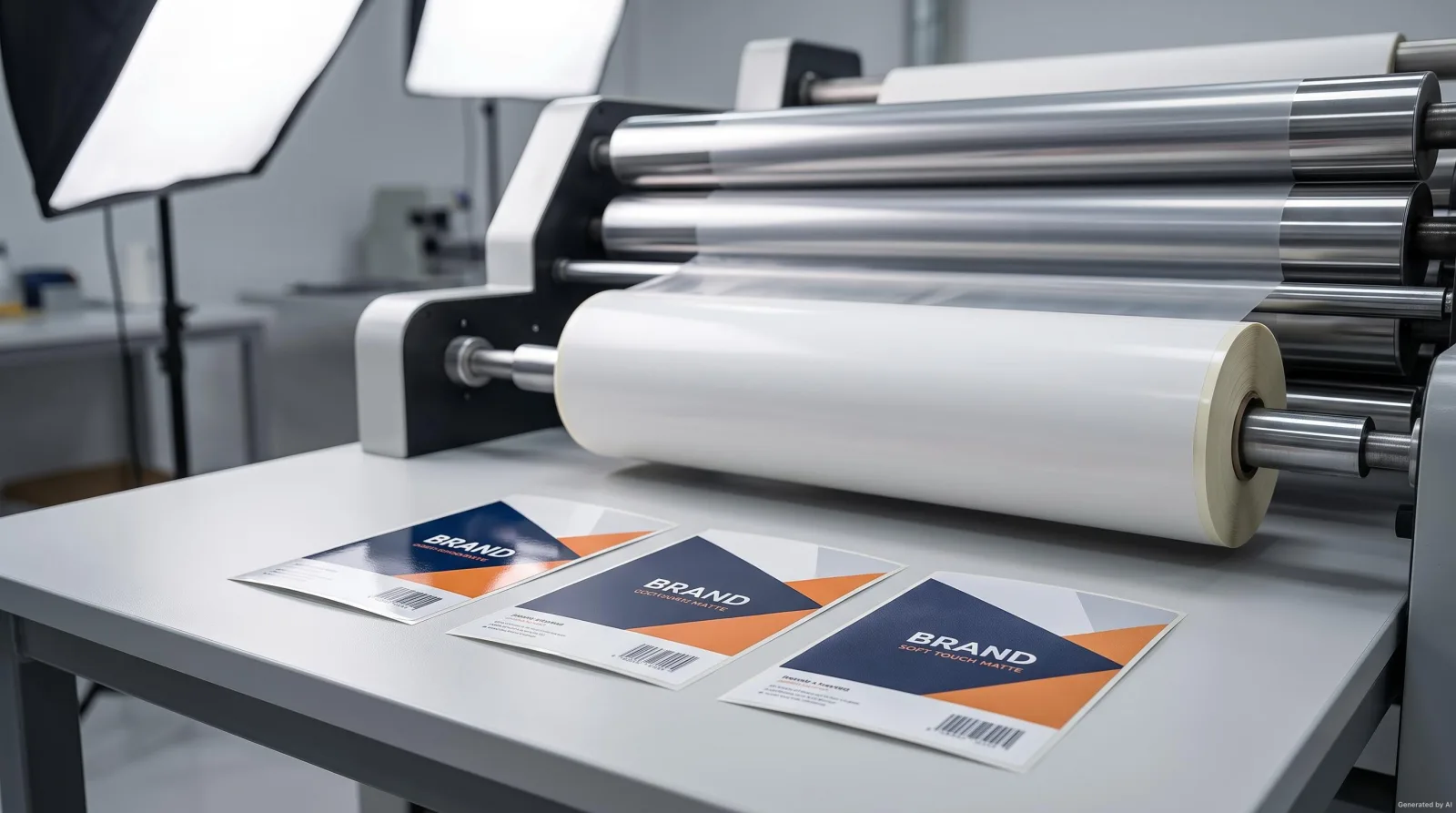
Matte and gloss are surface features that can be chosen somewhat independently of the film material, but they are not offered the same way on every material. A gloss surface shows colours vividly and sharply, reflects light and gives a premium impression. A matte surface reduces reflection, makes text easier to read and offers a calmer, more sophisticated look. Especially on barcode and small-print labels, a matte surface can improve readability.
Both matte and gloss are common on PP and PET. On PE, matte and opaque surfaces are more common. When choosing, consider where and how the label will be used: gloss surfaces can show fingerprints and scratches more, while matte surfaces hide smudges better.
Applications: food, cosmetics, chemical and outdoor
Material choice is usually shaped by the application. Below we summarise typical tendencies; every product should of course be assessed under its own conditions.
In food packaging, clarity and moisture resistance stand out. Clear PP or PET is often used to show the product behind. For refrigerated and humid environments, PE's flexibility and the moisture resistance of PP and PET are advantages. In cosmetics, a premium look matters: gloss PET and high-clarity PP give a refined impression.
For chemical and industrial products, chemical resistance is decisive, and here PET and PP stand out. For labels in contact with oil, solvents or cleaning products, the material should be assessed together with the adhesive and, if needed, a protective coating. Outdoors, UV, rain and temperature differences come into play; durable films and suitable adhesives are preferred for these conditions.
Recycling and sustainability
The three materials have different recycling stories. PET is one of the most widely recycled plastics in packaging, with a relatively developed collection infrastructure. PP is also a recyclable polymer used in many packaging types. PE is common in flexible packaging and its recyclability varies by type. The resin identification codes used to tell plastics apart (1 for PET, 5 for PP, 2 or 4 for PE types) appear on packaging.
One important point for labels is that the label should not make recycling the packaging harder. When the label and adhesive are chosen to be compatible with the packaging, recycling processes run more smoothly. For brands with sustainability goals, reducing material thickness, avoiding unnecessary layers and considering recyclable adhesives are meaningful steps.
Cost comparison
Cost cannot be expressed as a single number; material price, thickness, quantity, printing and adhesive are assessed together. As a general tendency, PP is seen as an economical option because it delivers good performance at a reasonable cost. PE is also usually affordable and can be efficient for flexible packaging. PET is generally the most expensive of the three because of its high performance, but in jobs that need long life and durability its total cost may become more favourable.
The point to watch here is that the lowest unit price is not always the most economical solution. The wrong material choice creates hidden costs through relabelling, returns or customer complaints.
PP, PE and PET feature comparison table
The table below summarises the typical tendencies of the three materials. Values may vary with product type, film thickness and adhesive; the table is a general guide.
| Property | PP (BOPP) | PE | PET (polyester) |
|---|---|---|---|
| Clarity | High | Medium | Very high |
| Surface feel | Smooth, semi-rigid | Soft, flexible | Rigid, glass-like |
| Flexibility / conformability | Medium | High | Low |
| Heat resistance | Medium | Low–medium | High |
| Chemical resistance | Good | Medium–good | Very good |
| Tear resistance | Good | Medium | Very good |
| Matte / gloss | Both common | Mostly matte/opaque | Both; gloss prominent |
| Typical use | Food, cosmetics, general | Flexible/squeezable packaging | Demanding, outdoor, premium |
| Relative cost | Economical | Economical | Higher |
| Recycling code | 5 | 2 or 4 | 1 |
Which one for which product?
- Clear food packaging (bottle, jar, box): clear PP or PET if the product should show through; PET when moisture resistance and clarity are both needed.
- Flexible and squeezable packaging (pouch, small pack): PE, as it conforms to a bending surface.
- Cosmetics and premium products: PET for a sharp, glossy, clear look; gloss PP for a good balance and an economical option.
- Chemical and industrial products: PET with high chemical resistance or durable PP; the adhesive must be matched to the product.
- Outdoor and demanding conditions: PET, as the most resistant to UV, moisture and temperature.
- Cost-driven general use: PP for affordable and balanced performance.
Selection checklist
- Is the surface flat, bendable or rough?
- Will the product be exposed to moisture, cold, oil or chemicals?
- Will the product face UV and temperature swings outdoors?
- Is high clarity or matte readability expected from the label?
- Is there a high risk of tearing and abrasion?
- Is the adhesive compatible with the chosen film and surface?
- Does the label's life match the product's shelf life?
- Are there recycling or sustainability targets?
- Have quantity, thickness and budget been balanced?
- If it is a demanding application, has a sample been tested?
A realistic use case
Consider a small business making natural soap. The soaps are handled by hand and sometimes stay humid, so the label must resist water and abrasion. At first a matte paper label is used, but it soon lifts at the edges. They then try a clear PP label: good moisture resistance, a clean look and a reasonable cost. For the part of production sold outdoors, the same business switches to a PET label, since PET behaves better against sun and temperature swings. In this way, one business balances cost and quality by using different film materials for different product groups.
This example shows that a single material is not ideal for every job. The right approach is to understand the product and its conditions, then choose the material and adhesive accordingly and, if needed, confirm it with a sample.
Conclusion and practical recommendations
Choosing among PP, PE and PET is not about finding the “best” material but about defining the product's needs correctly. The balance between clarity, flexibility, heat and chemical resistance and cost changes with the application. For a balanced and economical start, PP; for flexible packaging, PE; and for demanding conditions and high durability, PET usually provides a good framework.
When deciding, it helps to combine general material knowledge with your own product's conditions. To go deeper, you can read our articles on coated paper versus film labels, thermal labels versus coated paper labels, material selection for industrial labels and technical questions when choosing label material.
Let us choose the right material for your product together
Every product has a different surface, storage condition and expectation. Choosing the right film material and adhesive prevents lifting, fading or return problems later. Share your product type and use conditions, and we will recommend the most suitable PP, PE or PET solution and sample options. You can browse our range on the products page, or reach us through the request a quote page for a quick assessment.
Frequently Asked Questions
What is the main difference between PP, PE and PET?
All three are polymer-based films; the key difference is the chemical structure of the polymer and the film production method. PET is the stiffest and most dimensionally stable, PP is the balanced and most widely used one, and PE is the most flexible and best suited to bendable packaging.
Which material is best for a clear label?
PET offers the highest clarity and transparency, followed by gloss BOPP. Clear PE usually looks more matte and slightly milky, so it is not the first choice when full clarity is required.
Which film should be used for flexible and squeezable packaging?
PE is preferred for bending, squeezable or slightly deformed packaging because it conforms to the surface. It lets the label move with the product without cracking.
Which one is durable for demanding and outdoor conditions?
PET stands out in demanding applications that need chemical, heat and UV resistance. PP is also durable enough for many uses; matching the adhesive to the product is essential.
Which is the most economical in terms of cost?
As a general tendency, PP and PE are more economical while PET is more expensive. However, the lowest unit price is not always the most economical solution; the wrong choice can create hidden costs such as relabelling or returns.
Want to Determine the Right Label for Your Product?
Share your usage area and needs with us; let's evaluate suitable options together.